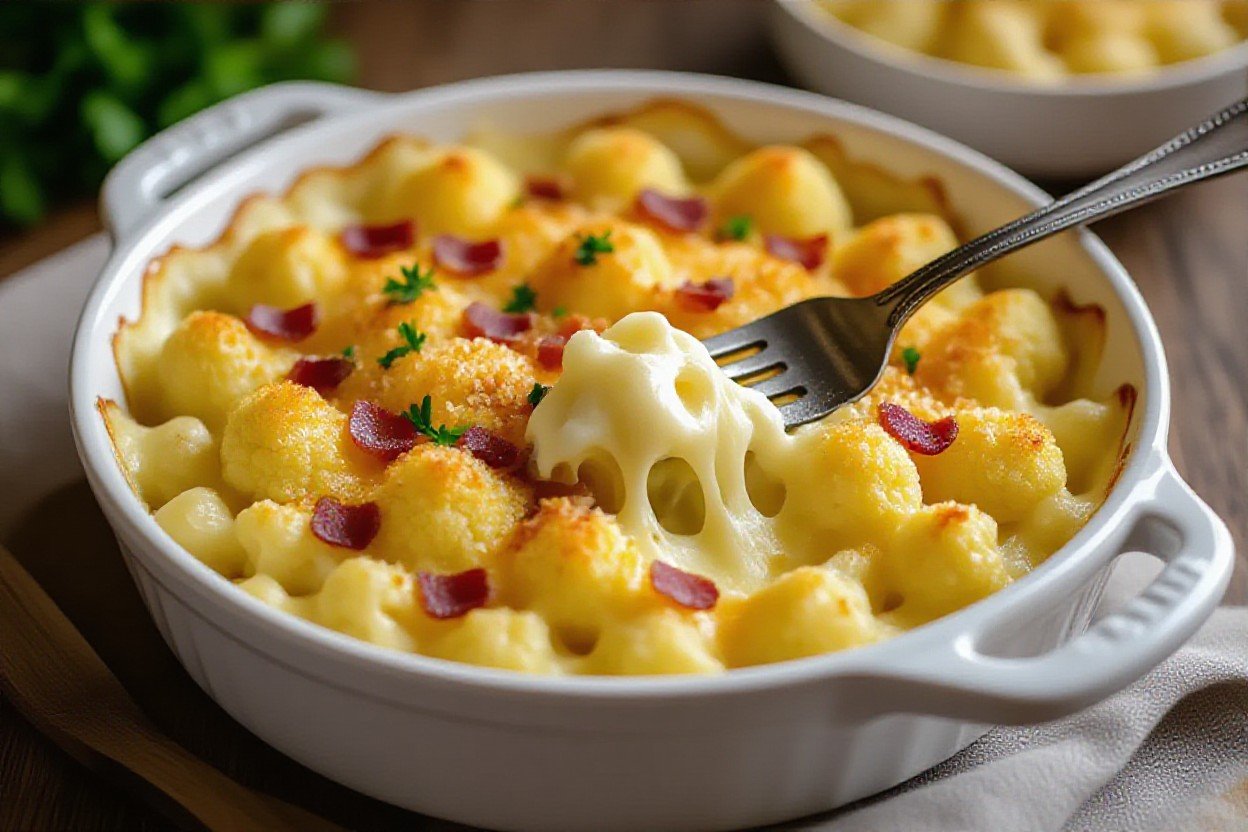
Keto Cauliflower Mac & Cheese
Over the last decade keto cooking has transformed comfort food, and this Keto Cauliflower Mac & Cheese shows you how to swap pasta for tender cauliflower while preserving creamy, cheesy satisfaction; you’ll learn simple techniques to achieve a silky cheese sauce, boost flavor with herbs and spices, and keep carbohydrates low so your meals stay compliant and satisfying without sacrificing texture or taste.
Understanding the Keto Diet
What is the Keto Diet?
When you lower your carbohydrate intake to roughly 20-50 grams per day and raise dietary fat to about 70-75% of calories (with protein around 20% and carbs 5-10%), your body shifts from glucose to fat as its primary fuel. This metabolic state-nutritional ketosis-is characterized by circulating ketone bodies such as beta‑hydroxybutyrate (typically 0.5-3.0 mmol/L), which your brain and muscles can use instead of glucose.
After 48-96 hours of consistent low-carb intake and depleted glycogen stores, most people begin producing measurable ketones; full adaptation may take 2-6 weeks. Because cauliflower is low in net carbs and high in fiber, swapping pasta for cauliflower florets or riced cauliflower in your mac & cheese keeps you within those carb limits while still delivering texture and volume.
Benefits of a Keto Lifestyle
Many people notice rapid initial weight loss-often driven by water and glycogen depletion-followed by sustainable fat loss as appetite decreases; studies typically show greater short-term weight loss versus low‑fat diets. Clinically relevant improvements in blood sugar control have been reported for people with type 2 diabetes, including reductions in fasting glucose and less reliance on glucose‑lowering medications when monitored by healthcare providers.
Because ketones provide a steady energy source, you may experience fewer energy spikes and crashes and reduced mid‑day hunger, which helps with adherence. In addition, lipid profiles often shift favorably for triglycerides and HDL; some individuals also report clearer mental focus and endurance during workouts when adapted to burning fat.
If you have existing medical conditions or take medications, work with your clinician to monitor electrolytes, renal function, and lipid panels-some people experience LDL increases that require individualized management-while tracking ketone levels and how your weight and performance respond over weeks rather than days.
Cauliflower as a Substitute
You can slash net carbs by roughly 80-90% when you swap cauliflower for traditional pasta or potatoes – for example, 1 cup of cooked elbow macaroni has about 43 g of carbs, whereas 1 cup of cooked cauliflower is closer to 5 g, with roughly 25 kcal per 100 g. Texture-wise, the method you choose determines success: riced cauliflower works best when steamed briefly then squeezed dry to avoid sogginess, while puréed cauliflower benefits from added fat (butter, cream cheese, or egg yolk) to recreate the silkiness of a béchamel-based sauce.
Because cauliflower has a high water content and neutral flavor, you’ll need to manage moisture and boost seasoning to match the mouthfeel of mac and cheese. Roasting at 425°F for 20-25 minutes concentrates flavor and reduces water, giving florets a nuttier profile that stands up well to sharp cheeses and smoky spices; alternatively, quickly sautéed riced cauliflower carries bold cheeses and mustard without becoming mushy.
Nutritional Profile of Cauliflower
Per 100 g, cauliflower supplies about 25 kcal, approximately 5 g total carbohydrates, roughly 2 g fiber (leaving ~3 g net carbs), and around 2 g protein, making it a very low-calorie, low-carb vegetable for ketogenic meals. It’s also a potent source of vitamin C (about 48 mg per 100 g, roughly half the daily value) and provides folate and small amounts of B vitamins, which help support metabolism when you’re cutting grains.
Beyond macros, cauliflower is part of the cruciferous family and contains glucosinolates and isothiocyanates – phytochemicals that have been associated in several studies with anti-inflammatory and cellular-protective effects. Glycemic impact is minimal, so you can use it to lower the overall glycemic load of a meal while keeping volume and satiety higher than many other low-carb swaps.
Advantages of Using Cauliflower in Cooking
Cauliflower’s biggest advantage is versatility: you can rice it, mash it, roast it into steaks, pulse it into a pizza crust, or purée it into a creamy sauce that replaces a flour-thickened béchamel. For keto mac and cheese specifically, cauliflower lets you retain a familiar plate composition – a mound of tender bites coated in cheese – while cutting net carbs from roughly 40+ grams to single digits per serving.
Another plus is how well cauliflower absorbs and amplifies added flavors. Fat-soluble seasonings like smoked paprika, mustard, nutmeg in cream sauces, or a splash of lemon juice really pop against the vegetable’s neutral backbone, so you can recreate complex profiles without relying on starch. It’s also widely available year-round and holds up to freezing, making batch-prep practical for meal planning.
On a practical level, aim to remove excess moisture for the best texture: after steaming or microwaving, press cauliflower in a clean towel or cheesecloth until most liquid is gone, and roast florets on a hot tray to add caramelization. If you need a thicker sauce without flour, combine egg yolks or a small amount of xanthan gum with warm cheese sauce to stabilize it – techniques that help your cauliflower mac and cheese look and feel closer to the original while staying true to keto macros.
Ingredients for Keto Cauliflower Mac & Cheese
Key Ingredients
You’ll want one medium head of cauliflower (roughly 600-800 g), which yields about 6-8 cups of florets once trimmed and chopped; this is the backbone that keeps the dish low-carb compared with a typical cup of elbow pasta that has roughly 30-40 g of carbs. For the cheese sauce use 2 cups (about 200 g) of a sharp cheddar for flavor and melting power, supplemented by 2 oz (56 g) cream cheese and 1/4 cup (60 ml) heavy cream for silkiness; these amounts give you a rich, cohesive sauce without thinning the keto profile.
To bind and season the sauce, add 1 large egg if you want a firmer bake, 1 teaspoon Dijon mustard, 1/2 teaspoon garlic powder, and a pinch of nutmeg or smoked paprika for depth, plus salt and black pepper to taste. Finish with 2 tablespoons butter for mouthfeel and 1/4 cup grated Parmesan stirred into the top for a golden crust; using full‑fat dairy keeps each serving typically under 8 g net carbs depending on portion size and add-ins.
Optional Add-ins and Variations
When you customize, think in measured increments: 4 slices of cooked, crumbled bacon add savory crunch; 1 cup cooked, chopped spinach (squeezed dry) brings color and nutrients; 1/2 cup sautéed mushrooms adds umami but must be cooked down to remove excess moisture. For cheese swaps, try 1 cup smoked gouda or 1 cup Gruyère in place of half the cheddar for a nuttier profile, or use 1 cup shredded mozzarella if you want a stretchier texture.
For crunchy toppings and keto-friendly “breadcrumbs,” use 1 cup crushed pork rinds mixed with 2 tablespoons grated Parmesan, or a 1:1 blend of 1/3 cup almond meal and 1/3 cup grated Parmesan toasted briefly. If you want a themed variation, add 3-4 tablespoons buffalo sauce and 1/2 cup crumbled blue cheese for a Buffalo version, or 3/4 cup cooked chorizo and 1 cup pepper jack for a Mexican twist; adjust salt and spice to taste.
Pay attention to moisture: any wet add-in (spinach, mushrooms, thawed frozen cauliflower) should be cooked and well-drained before mixing so the sauce thickens properly, and if you use riced cauliflower instead of florets reduce the bake time and squeeze out excess liquid to avoid a watery casserole.
Step-by-Step Cooking Instructions
| Stage | Quick Details |
|---|---|
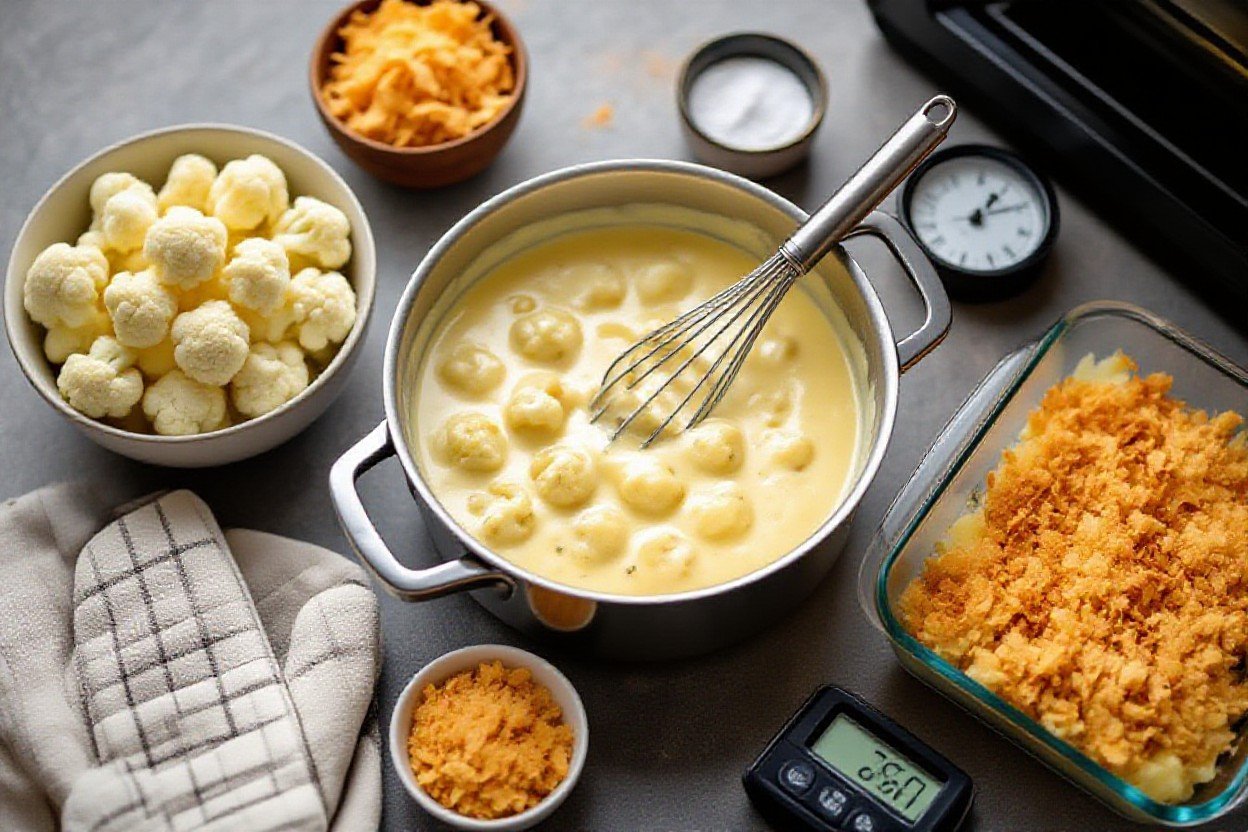
| Preparing the Cauliflower | Cut into 1-1.5″ florets, toss with 1 tbsp olive oil and ½ tsp salt. Roast at 425°F (220°C) for 18-22 minutes (flip once) until golden, or steam 6-8 minutes then pat dry. A medium head (~600-700 g) yields ~5 cups florets. |
| Creating the Cheese Sauce | Melt 2 tbsp butter, whisk in 4 oz (115 g) cream cheese, add ½ cup (120 ml) heavy cream. Stir in 2 cups (200 g) shredded sharp cheddar + ½ cup (50 g) Parmesan off the heat to avoid graininess; season with 1 tsp Dijon, ½ tsp garlic powder. Thicken with ¼-½ tsp xanthan gum or 1 tbsp almond flour if needed. |
| Combining and Baking | Toss cauliflower with about ¾ of the sauce, transfer to a 9×13″ (23×33 cm) dish, top with remaining sauce and ½ cup extra cheddar. Bake at 400°F (200°C) for 10-12 minutes until bubbling; broil 1-2 minutes for color. Let rest 5-8 minutes before serving. |
Preparing the Cauliflower
Cut the florets to roughly 1-1.5 inches so they cook evenly; uneven pieces produce a mix of overdone and underdone bites. You should preheat the oven to 425°F (220°C) for roasting-toss florets with 1 tablespoon olive oil, ½ teaspoon kosher salt and a pinch of black pepper, spread in a single layer, and roast 18-22 minutes, flipping once, until the edges caramelize.
If you prefer steaming, steam 6-8 minutes until fork-tender, then transfer to a towel or salad spinner and press out excess moisture-wet cauliflower will dilute the sauce and create a soggy bake. For frozen florets, thaw fully and press out 3-4 tablespoons of water; if they still feel damp, roast 5-7 minutes to drive off extra moisture.
Creating the Cheese Sauce
Begin by melting 2 tablespoons unsalted butter over low heat, then whisk in 4 oz (115 g) cream cheese until smooth; slowly pour in ½ cup (120 ml) heavy cream and bring to a gentle simmer-keeping the heat low prevents the fats from separating. After the base is silky, add 2 cups (about 200 g) freshly shredded sharp cheddar and ½ cup (≈50 g) grated Parmesan in small additions, stirring until each addition melts before adding the next.
Season the sauce with 1 teaspoon Dijon mustard, ½ teaspoon garlic powder and ¼ teaspoon onion powder, plus salt and black pepper to taste; if you want a touch of brightness, stir in 1 tablespoon lemon juice. For a keto-friendly thickener, sprinkle ¼-½ teaspoon xanthan gum while whisking or whisk in 1 tablespoon almond flour-both will add body without flour.
To avoid graininess, use freshly shredded cheese (pre-shredded often contains anti-caking agents) and remove the pan from direct heat when you add the cheese; the ideal finished sauce will coat a spoon and fall in a ribbon, yielding roughly 350-400 ml of sauce for a 4-serving casserole.
Combining and Baking
Mix the roasted or well-drained cauliflower with about three-quarters of the cheese sauce so the florets are evenly coated-add more sauce if pieces look dry. Transfer the mixture to a 9×13″ (23×33 cm) baking dish, smooth the top, then spoon the remaining sauce over and sprinkle ½ cup extra shredded cheddar or a ¼ cup Parmesan-pork rind crumb blend for a crisp top.
Bake at 400°F (200°C) for 10-12 minutes until the casserole is bubbling and the top takes on golden color; for deeper browning, broil 1-2 minutes while watching closely. After removing from the oven, let the dish rest 5-8 minutes so the sauce sets and you get cleaner portions when serving.
If you plan to reheat, divide into portions and refrigerate up to 3 days; reheat at 350°F (175°C) for 10-15 minutes or microwave in 60-second bursts, stirring once-add 1-2 tablespoons of cream if the sauce tightens up during storage.
Serving Suggestions
Pairing Ideas
You can serve this keto cauliflower mac & cheese as a hearty main alongside a simple, acidic salad to cut through the richness – for example, a 2-cup mixed-green salad with lemon vinaigrette keeps the plate bright while adding only 1-2 g net carbs. For proteins, pair with 4-6 oz portions of roasted chicken thighs, pan-seared salmon, or a 5-6 oz pork chop; those choices provide 20-30 g of protein and complement the cheesy texture without adding many carbs.
To build variety, add texture with 2 strips of crispy bacon or 1-2 tablespoons of crushed pork rinds and finish with fresh chives or a sprinkle of smoked paprika. If you drink alcohol, choose dry white or brut sparkling wines, which typically contain about 1-3 g carbs per 5-oz pour, or stick with unsweetened iced tea or sparkling water to keep the meal low-carb and refreshing.
- Grilled or roasted chicken (4-6 oz) – a lean, filling partner that balances the cheese.
- Arugula or mixed greens with lemon and olive oil – acidity cuts richness and adds vitamins A and K.
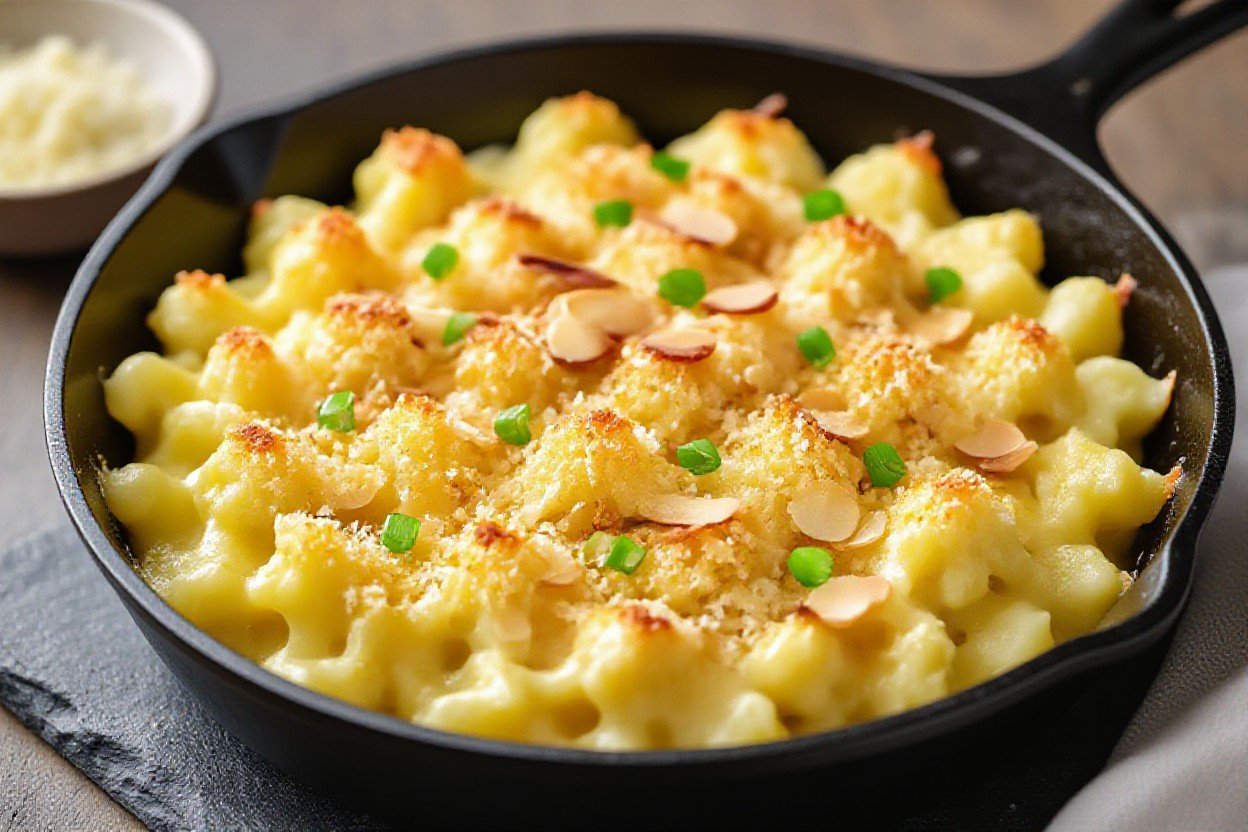
- Crispy bacon bits or toasted almond slivers for crunch – 1-2 tbsp adds texture with minimal carbs.
- Recognizing that your daily carb target matters, adjust portion sizes and accompaniments to stay within your personal limit.
Storage and Reheating Tips
You should cool the casserole to room temperature no longer than 2 hours, then transfer to airtight containers and refrigerate; stored this way it will keep for up to 4 days. When reheating refrigerated portions, preheat the oven to 350°F (175°C), cover the dish to retain moisture and heat for 15-20 minutes, then uncover for 3-5 minutes to restore a golden top – if you prefer the microwave, heat single servings 60-90 seconds, stir, then heat another 30 seconds as needed.
Freeze single portions in freezer-safe containers or vacuum bags for up to 2 months and label with the date; thaw overnight in the refrigerator before reheating. When reviving texture and creaminess, stir in 1-2 tablespoons of heavy cream or a small handful (about 1/4 cup) of shredded cheddar while warming – that often restores a silky mouthfeel without adding many carbs.
- Refrigerate in shallow, airtight containers within 2 hours; good for up to 4 days.
- Freeze portions up to 2 months; thaw overnight in the fridge before reheating to ensure even warming.
- Reheat refrigerated servings at 350°F for 15-20 minutes covered, or bake frozen portions at 375°F for 25-35 minutes covered, then uncover to crisp the top.
- Recognizing that cauliflower’s texture softens after freezing, use a splash of cream or extra cheese during reheating to bring back a creamier consistency.
Nutritional Information
Per typical serving (about 1 cup / 220 g), this keto cauliflower mac & cheese contains roughly 340 kcal, ~28 g fat, ~14 g protein, and ~6 g net carbs (about 10 g total carbs with ~4 g fiber). Sodium will vary with the cheese you choose but often lands near 700-900 mg per serving when using sharp cheddar and added salt.
Micronutrient-wise, one serving supplies meaningful calcium (approximately 250-350 mg depending on cheese choices) and vitamin C from the cauliflower (around 20-30 mg, about 25-35% of the RDI). Swapping ingredients-heavy cream vs half‑and‑half, full‑fat vs part‑skim cheese-will shift calories and fat by 10-25% per substitution.
Macronutrient Breakdown
The recipe skews high in fat: expect around 70-75% of calories from fat in the standard version, with saturated fat making up roughly 10-12 g of the total (from butter, cream, and cheese) and the remainder coming from monounsaturated fats. Protein primarily comes from the cheese and any added meats (about 12-16 g per serving), while net carbohydrates are low-typically 5-7 g-coming almost entirely from the cauliflower and small amounts in dairy.
If you need to tweak macros, you can increase the ketogenic fat ratio by adding 1 tablespoon of butter (about +11.5 g fat, +100 kcal) or 1 tablespoon of heavy cream (+5 g fat, +50 kcal). Conversely, lowering portion size or choosing lower‑fat dairy drops calories and fat while keeping protein and net carbs relatively stable.
Serving Size Recommendations
Use 1 cup (≈220 g) as a standard side portion: ~340 kcal, ~28 g fat, ~14 g protein, ~6 g net carbs. Choose 3/4 cup (≈165 g) for a lighter side-about 255 kcal, ~21 g fat, ~10.5 g protein, ~4.5 g net carbs-or 1.5 cups (≈330 g) when the dish is your main entree, roughly 510 kcal, ~42 g fat, ~21 g protein, ~9 g net carbs. These estimates scale linearly with portion size.
Match portion size to your daily targets and activity level: if you keep carbs under 20 g per day, a 1‑cup serving consuming ~6 g net carbs uses about 30% of that allowance, so you may prefer 3/4 cup alongside low‑carb proteins and vegetables. For athletes or those with higher calorie needs, the 1.5‑cup option helps meet energy and fat targets without adding carbs.
When precision matters, weigh portions and log them: on a 1,600 kcal/day ketogenic plan targeting ~75% calories from fat (≈133 g fat/day), a 1‑cup serving with ~28 g fat provides about 21% of your daily fat goal, so you can adjust other meals accordingly to stay within macro targets.
To wrap up
Taking this into account, Keto Cauliflower Mac & Cheese gives you the creamy, comforting experience of classic mac and cheese while keeping carbohydrates minimal. By avoiding overcooking the cauliflower, draining it well, using a mix of cheeses with a bit of cream or cream cheese for richness, and finishing briefly under the broiler for a golden top, you’ll achieve the right texture and depth of flavor that aligns with your macros.
Store leftovers tightly refrigerated for 3-4 days and reheat gently to preserve creaminess, and customize the dish with additions like cooked bacon, shredded chicken, or roasted vegetables to increase protein and nutrients without adding many carbs. With these adjustments you can confidently make this recipe a dependable, satisfying option in your keto meal plan.
Printable Recipe Card
Want just the essential recipe details without scrolling through the article? Get our printable recipe card with just the ingredients and instructions.