Smoked Salmon Rosettes
With smoked salmon rosettes, you might think they’re just fussy restaurant food, more pretty than practical, but that’s not the case at all. Once you understand how the slices behave and how to roll them, you’ll see you can actually pull these off in your own kitchen without losing your mind. You’ll learn how to shape, plate, and season them so they look pro-level, taste clean and rich, and actually hold together when your guests pick them up. And yep, you’ll be able to tweak them to your own style, not just copy a fancy menu photo.
Key Takeaways:
- People assume smoked salmon rosettes are super chef-y and fussy, but they’re basically just rolled slices with a tiny bit of shaping – if you can roll a ribbon, you can make these. The trick is using cold salmon, not overstuffing with filling, and twisting from the center so it naturally curls into that pretty flower shape.
- They’re perfect make-ahead party bites because the salmon actually holds up really well in the fridge, and the flavors mellow together. Layer them on cucumber rounds, blinis, or little toast squares, then add a swipe of cream cheese or herbed mascarpone and you’ve basically got instant “wow” factor with very little effort.
- Garnishes are what make them look restaurant-level: tiny dill sprigs, cracked black pepper, a few capers, or a squeeze of lemon bring everything to life. Keep the seasoning simple, let the salty-smoky salmon stay the star, and use small rosettes so people can eat them in one or two bites without the whole thing unraveling.
What’s a Smoked Salmon Rosette Anyway?
So What Are You Actually Making?
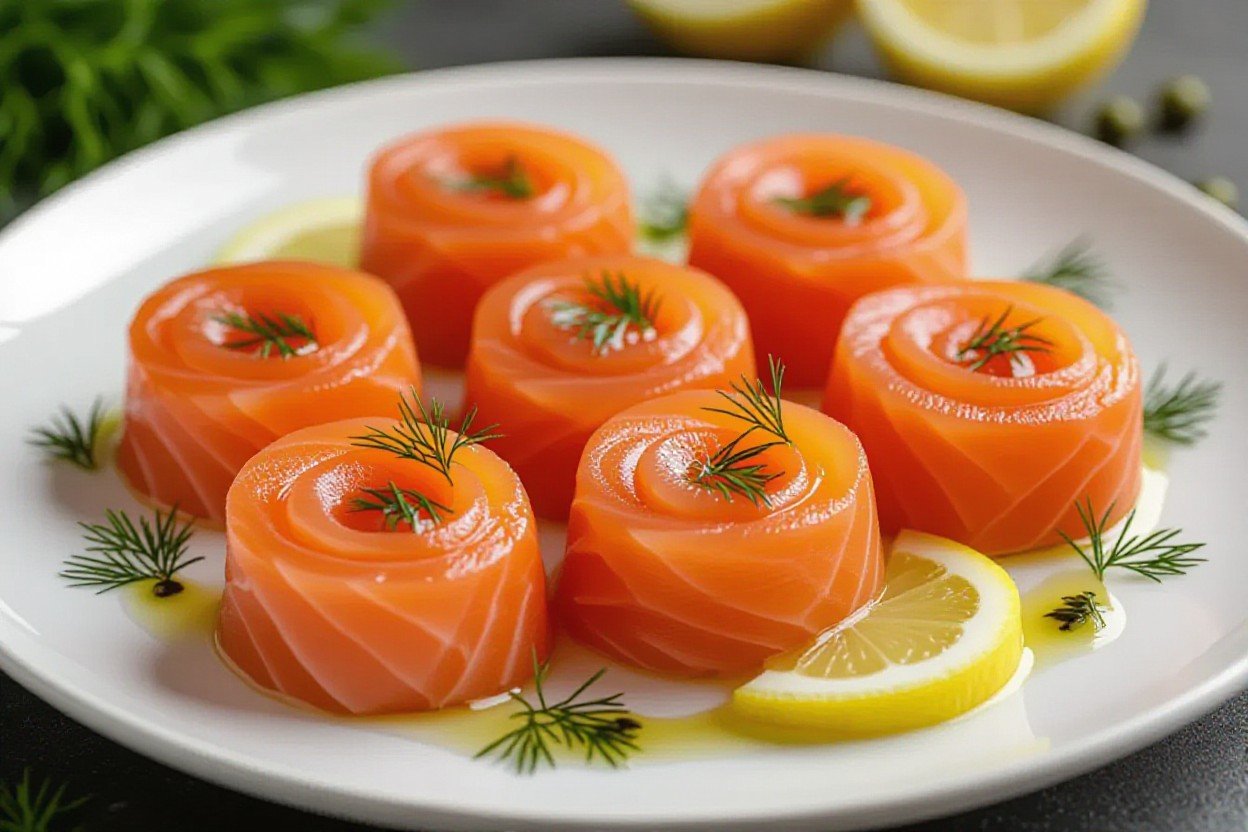
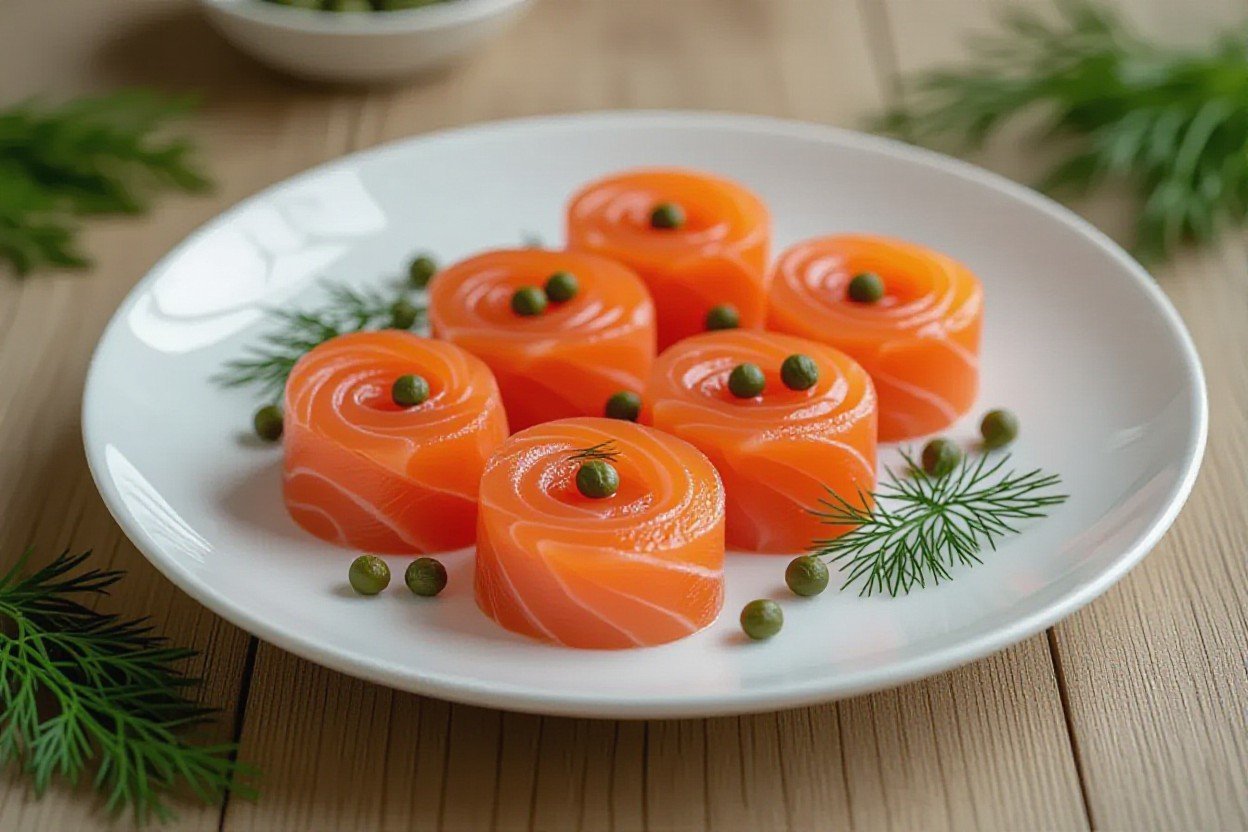
Roughly 90% of the smoked salmon rosettes you see on Instagram are nothing more than a single slice rolled into a spiral and nudged into a flower shape with your fingers. You’re basically taking a 2-inch wide strip of smoked salmon, rolling it from one short edge to the other, then loosening the top layers a bit so it fans out like petals – that’s it, that’s the “fancy” technique. If you’ve ever rolled deli meat for a party platter, you already get the idea, you’re just tightening the center and fluffing the edges so it looks intentional instead of accidental. And because cold-smoked salmon is soft and pliable, you can reshape it as you go without it tearing to bits, which makes it way more forgiving than it looks on the plate.
The Anatomy Of A Rosette
Every smoked salmon rosette has three basic parts: the core, the petals, and the base that actually keeps it from falling over. You create the core by rolling the first half of the slice pretty snug, then you let the remaining bit relax so it opens up into looser layers – that contrast between tight center and ruffled edges is what tricks your guests into thinking you spent 15 minutes on each one. Underneath, you’re usually parking the rosette on something sturdy like a cucumber round, a blini, or a baguette slice about 1/4 to 1/2 inch thick, so it has a flat “stage” to sit on and you aren’t fighting gravity the whole time. Once you see it broken down like that, you realize you’re not doing arts and crafts with fish, you’re just stacking simple elements in a way that looks polished instead of thrown together.
Why I Think They’re the Perfect Appetizer
They Punch Way Above Their Weight
You know that moment when guests walk in and instantly scan the table to see what you’ve made? This is where smoked salmon rosettes quietly steal the show. You’re working with maybe 15 to 20 grams of salmon per rosette, a teaspoon of herbed cream cheese, a squeeze of lemon, yet people react like you catered the party from a fancy hotel. On a standard 12-inch platter you can comfortably fit 18 to 24 rosettes, which is basically enough to keep 8 to 10 people happily nibbling while you finish the main course and sip your own drink in peace.
What makes them so effective is that you get salty-fatty-smoky-acid in a single bite, so guests feel satisfied without filling up. You can keep the base simple with cucumber rounds or blini, then swap toppings to match your crowd: dill and capers for the traditionalists, everything-bagel seasoning for brunch people, a tiny dot of wasabi mayo for your spice lovers. And because each rosette is literally a 15-second assembly job once you’ve prepped your elements, you can batch out 30 of them in under 15 minutes and it looks like you spent an hour.
They Solve About Five Hosting Problems At Once
On a practical level, you’re also dealing with something that behaves really nicely at a party. The rosettes hold their shape for at least 45 to 60 minutes in a reasonably cool room, especially if you chill the platter first, so you’re not chasing slumping canapés or soggy pastry. They’re naturally gluten-free if you park them on cucumber or potato slices, low-carb, high in protein and healthy fats, and you can do dairy-free versions with a cashew spread or whipped avocado without anyone feeling like they got the “diet” option.
Another big win is how flexible they are with timing. You can roll the salmon strips and pipe or spoon your filling up to 4 hours ahead, keep them covered in the fridge at around 4 °C, then assemble on the base right before serving so everything stays perky. Because they’re bite-sized and not messy, people can eat them with one hand while holding a drink, which reduces glass spills and random crumbs all over your sofa. For a small gathering, 3 to 4 rosettes per person is perfect; for a big cocktail party, plan on 5 to 6 each, and you’ve got a reliable, good-looking anchor for your whole spread.
How to Make Smoked Salmon Rosettes Like a Pro
The Ingredients You Really Need
Ever notice how some smoked salmon rosettes look flawless and others kind of slump over and fall flat on the plate? That gap usually comes down to the ingredients you pick, not your shaping skills. You want salmon that’s flexible, not crumbly, with slices about 1.5-2 mm thick, because if they’re too thick you’ll fight them into shape, and if they’re too thin they tear the second you start rolling. Aim for evenly sliced cold-smoked salmon, ideally pre-sliced from the belly or mid-section, since tail pieces are often too narrow for clean petals.
Beyond the fish, you really only need a few supporting players, but they should be specific, not random fridge scraps. A mild, full-fat dairy base (like 30-35% fat cream cheese or mascarpone) gives you a smooth, pipeable texture that holds its shape for at least 45-60 minutes on a buffet table, especially if you mix in a small amount of lemon juice and a pinch of salt to sharpen the flavor. Then you layer in your personality shots: ultra-fine chopped chives, a little grated lemon zest, maybe a tiny spoon of prepared horseradish if you want some heat without blowing out your guests’ sinuses.
| Ingredient | Why You Actually Need It |
| Cold-smoked salmon, evenly sliced | Gives you flexible “petals” that roll smoothly without cracking, and the uniform thickness keeps every rosette looking consistent on the platter. |
| Full-fat cream cheese or mascarpone | Sets up nicely in the fridge, pipes cleanly through a small tip, and provides a neutral, creamy base that won’t overpower the salmon. |
| Lemon juice and zest | Adds brightness that cuts through the salmon’s richness, while the zest brings aroma without watering down your filling. |
| Fresh herbs (chives, dill, or parsley) | Gives you specks of color and a fresh hit of flavor, making each bite taste intentionally layered, not just “cream plus fish”. |
| Ground black pepper | Provides gentle heat and depth, especially useful if your salmon is mild or you’re using unsmoked dairy in the filling. |
| Crackers, blinis, or cucumber rounds | Act as your serving base, adding crunch or freshness while keeping the rosettes easy to pick up with fingers at a party. |
| Capers or salmon roe (optional garnish) | Give you a textural pop and visual contrast, plus a salty punch that makes a tiny rosette taste like a complete bite. |
Step-by-Step Instructions
So how do you actually turn floppy salmon slices into those tight little roses that sit up straight on the plate? You start by setting yourself up like a mini assembly line, because that one step alone can cut your prep time by a third. Lay out your board, pat the salmon dry with paper towel so it isn’t slippery, load your filling into a piping bag (even a zip bag with the corner snipped works) and have your bases arranged in neat rows so you can move fast once your hands get a bit fishy.
Once everything’s ready, you shape in stages instead of trying to nail a perfect rose in a single move. You create a tight inner bud with a short strip, then wrap one or two slightly longer strips around it with a small overlap, almost like you’re spiraling a ribbon, gently flaring the top edges to mimic petals. Each rosette then lands on its base, gets chilled for 15-20 minutes to firm up, and only after that do you add any delicate finishing touches like herbs or roe, which keeps them from getting bumped off while you’re still moving things around.
| Step | What You Do In Practice |
| 1. Prep the filling | Beat cream cheese with lemon juice, zest, herbs, salt, and pepper until smooth, then transfer to a piping bag and chill 10 minutes so it thickens slightly. |
| 2. Dry and portion the salmon | Pat each slice dry, then cut into strips about 2-3 cm wide; use shorter pieces for the inner core and longer pieces for outer petals. |
| 3. Pipe a small base of filling | On each cracker or cucumber slice, pipe a small mound of filling, roughly the size of a grape, so the rosette has something to grip. |
| 4. Roll the inner bud | Tightly roll a short salmon strip into a little cylinder, about 1.5 cm across, then gently pinch the base to keep it from unrolling. |
| 5. Add outer petals | Wrap one or two longer strips around the bud with a 3-5 mm overlap, slightly loosening the top edge to create a ruffled petal effect. |
| 6. Seat the rosette on its base | Press the bottom of the rosette gently into the piped filling so it stands upright and doesn’t slide around during chilling. |
| 7. Chill to set | Refrigerate the tray for 15-20 minutes; this firms up the cheese and helps the rosettes hold their shape for serving. |
| 8. Finish and garnish | Right before serving, top with tiny herb sprigs, a caper or two, or a few pearls of salmon roe for color and texture. |
What usually surprises people is how quickly you’ll get faster once you treat rosettes like a repeatable system instead of a piece of edible origami. If you batch each step – cutting all strips at once, piping all the bases in a row, then rolling rosettes in sets of 6 at a time – you can realistically turn out 24 neat little roses in under 20 minutes after a couple of practice runs. And because you’re chilling them in between, you buy yourself a 1-2 hour serving window where everything still looks sharp, which is exactly what you want if you’re plating ahead for brunch or a cocktail party.

Serving Suggestions: Making It a Showstopper
Plating That Looks Like It Walked Out Of A Restaurant
You care about how these look because, let’s be real, people eat with their eyes first and smoked salmon rosettes practically beg to be shown off. Start with a large white platter or a dark slate board so the pink pops, then cluster rosettes in groups of 3 or 5 instead of lining them up like soldiers – odd numbers always look more natural and relaxed. You can tuck thin lemon wedges and little sprigs of dill between them, then add some contrast with something crunchy like shaved cucumber ribbons or thin radish slices. If you want it to look like a legit catering spread, give yourself about 8 to 10 rosettes for a small board that serves 4 people as an appetizer, and double that for a party board where they’re the main star.
For extra drama, you can play with height, not just color. Stack a few rosettes on a small upside-down ramekin hidden under parchment so some sit higher than others, or place a low bowl of creme fraiche in the center and have the rosettes radiating out like petals. A quick drizzle of high quality olive oil or a glossy brush of honey-mustard glaze on just a few rosettes makes them catch the light, which sounds fussy but takes, what, 30 seconds. And if you add toasted brioche rounds or small rye triangles around the edge, suddenly your rosettes feel like a complete, intentional setup instead of “I just put salmon on a plate”.
My Take on Pairing Drinks with Smoked Salmon Rosettes
You know that moment when you take a bite of silky smoked salmon and sip something that just makes the flavor pop… and then another sip just sort of flops? That contrast is exactly why I started tracking my pairings years ago, almost like a nerdy little tasting diary. With these rosettes, you’re dealing with fat, salt, and smoke, so a dry, high-acid white like a classic Chablis or a Riesling with about 8-12 g/L residual sugar hits that sweet spot of cutting through richness without bulldozing the fish. If you prefer bubbles, a Brut Champagne or cava with fine bubbles and around 6-8 grams of dosage keeps the texture airy so your palate doesn’t get tired halfway through the platter.
For a lot of you, though, it’s not about fancy labels, it’s about what actually works on a Tuesday night when you’ve grabbed salmon, cream cheese, and whatever’s in the wine rack. So lean into crisp, clean styles: a New Zealand Sauvignon Blanc with those zippy citrus notes, or a dry Prosecco kept nicely chilled around 8-10°C so it stays refreshing with the salty bite of the rosettes. If you’re more of a spirits person, a small measure of chilled vodka or aquavit pairs surprisingly well – you get that clean, almost palate-reset effect between bites, especially if your rosettes have a bit of dill or pickled onion going on.
Common Mistakes – Don’t Mess This Up!
Overdoing the Filling & Wrecking the Texture
Too much filling is the fastest way to turn elegant rosettes into sloppy little blobs. When you pile on a thick line of cream cheese or mousse, the salmon can’t roll tightly, the seam pops open, and you end up fighting gravity on the platter. You want a thin, even smear – think 1 to 2 teaspoons per slice at most – so the salmon stays the star and the filling just adds support and flavor. If you can see big ridges of filling bulging out the sides, you’ve gone way past what the slice can actually hold.
Another thing you might not realize: using fridge-cold filling makes your life harder. Cold cream cheese or ricotta is stiff, so it tears delicate salmon as you try to spread it, and you get that streaky, broken look instead of a smooth layer. Let your filling sit out 10 to 15 minutes so it softens slightly, then spread it with a small offset spatula or even the back of a teaspoon. You’ll use less, it’ll spread cleaner, and your rosettes will actually stay rolled instead of springing open halfway through your party.
Handling, Seasoning & Assembly Timing
What trips a lot of people up is manhandling the salmon like it’s deli ham. If you pinch, stretch, or keep peeling it off the board over and over, the slices start to shred and that pretty rosette effect disappears. You want to touch each slice as few times as possible: lay it flat, spread, roll, shape, done. Use a cool board, dry hands, and if your kitchen’s warm, stash the tray in the fridge for 5 minutes halfway through so the fat in the salmon doesn’t go soft and greasy on you.
Salt and acidity are another common area where things go sideways fast. Smoked salmon is already salty – if you add salty capers, a salty cheese, and then sprinkle more flaky salt “for good measure,” you end up with something that tastes like a salt lick. Instead, you balance it: one salty element (the salmon), one bright or tangy element (lemon zest, a tiny squeeze of juice, or a quick dill yogurt), and maybe one textural topper like finely minced cucumber or radish. And timing matters more than you think: assemble no more than 2 hours ahead, keep the rosettes chilled, and only add anything wet or crisp – micro herbs, caviar, citrus zest, that last hit of pepper – in the final 15 to 20 minutes so your garnishes stay fresh and your salmon doesn’t water out on the plate.
To wrap up
About 70% of what guests comment on at a party is how the food looks, and your smoked salmon rosettes absolutely nail that first impression while still backing it up with serious flavor. Now you know how to shape the ribbons, balance the richness with bright little accents, and plate everything so it actually feels restaurant-level, you’re not just serving another appetizer – you’re setting the tone for the whole gathering. You’ve seen how a few simple choices (the right thickness of salmon, a squeeze of citrus, a crisp base) change the whole vibe, so you can tweak things to match your crowd, your time, and your pantry without stressing over perfection.
What really matters is that you’ve got a flexible little showpiece in your back pocket that works for brunch, date night, holidays, or just because you felt like treating yourself. So use your rosettes as a kind of canvas – swap herbs, play with different creams, try bolder garnishes – and let them evolve with your taste. When you can turn a basic pack of smoked salmon into something that looks this polished and tastes this good, you’re not just following a recipe anymore. You’re building your own style in the kitchen.
Printable Recipe Card
Want just the essential recipe details without scrolling through the article? Get our printable recipe card with just the ingredients and instructions.